The safest way to move a bicycle is to remove the parts that stick out, wrap the frame in padding, and load it where nothing heavy can lean on it. That means pedals off, handlebars turned or lowered, and the whole bike strapped down so it cannot slide or fall. The job takes about 30 minutes, and it costs far less than replacing a bent derailleur or a scratched frame.
Bikes are awkward cargo: light for their size, full of delicate parts, and shaped to catch on everything around them. A bike tossed in the back of a truck with a sofa and a stack of boxes will usually arrive with scuffed paint, a twisted rear derailleur, or a bent brake lever.
This guide walks through the whole process in order: what to do before you start, what to take off, how to wrap the frame, where to load it, and when it is worth buying a bike box.
Decide How the Bike Will Travel First
The right method depends on distance and value. A kid’s bike on a ten-minute local move needs less protection than a carbon road bike headed across the country.
For a short local move, the simplest option is to carry the bike in your own car or on a rack. Many people prefer this for a bike they ride daily, because it keeps it away from the chaos of the truck. If you go this route, a trunk or hitch rack still needs padding where the frame touches the rack.
For anything going in a moving truck, plan to do some light disassembly and padding. For a long-distance move, a high-value bike, or an e-bike, boxing is worth serious thought, and a later section covers that.
Before you touch a tool, do three small things:
- Clean the bike. Dirt and grit trapped under padding act like sandpaper during a bumpy drive.
- Take a few photos of the bike from both sides. They help if you ever need to prove its condition before the move.
- Gather supplies: a pedal wrench or hex key, an adjustable wrench, moving blankets, stretch wrap or soft ties, painter’s tape, and a zip-top bag for small parts.
How to Move a Bicycle: What to Remove and What to Leave
Take off anything that sticks out, hangs loose, or can snag. Leave anything that makes reassembly harder than it needs to be. Most bikes need only the pedals, the handlebar adjustment, and sometimes the front wheel removed.
Pedals
Pedals jab into other items and gouge frames, so they should come off. One detail trips people up: the two pedals do not unscrew in the same direction. According to Park Tool, the right pedal loosens counterclockwise, while the left pedal has a reverse thread and loosens clockwise. Many pedals are stamped “L” and “R,” which helps you keep them straight.
Put the pedals in a labeled bag and tape it to the frame or keep it with the other small parts.
Handlebars
You have two choices. The first is to loosen the stem bolt and turn the handlebars so they sit parallel to the frame. The second, for bikes that must fit in a tight space, is to loosen the stem and lower or remove the bar.
Turning the bars is faster and usually enough. If you take the bars off completely, tape any cables to the frame so they are not stretched or kinked. Never let the bars dangle by the brake or shifter cables.
Wheels and seat
Removing the front wheel makes the bike much narrower and easier to place. Skip it if you have no quick-release or thru-axle know-how. Lower the seat all the way, or remove it and wrap the post so it does not scratch the paint.
If you remove a wheel, put a small piece of cardboard or foam between the brake pads on a rim-brake bike, and on a disc-brake bike do not squeeze the brake lever while the wheel is out.
E-bike batteries
If you are moving an electric bike, take the battery off and carry it separately. A lithium-ion battery is the one part of a bike you should treat as a hazardous item. The U.S. Consumer Product Safety Commission noted in a 2025 warning about certain e-bike batteries that some fire incidents happened while the product was in storage and not charging. The same warning says hazardous lithium-ion batteries should not go in the trash or regular recycling.
A practical rule: keep the battery with you in the car, in a cool spot, away from anything flammable, and check the label or manufacturer notes before you ship or fly with it.
Wrap the Frame So Nothing Rubs
Frame protection comes down to padding the points where metal meets metal, and keeping the padding from sliding. Moving blankets do the job for most bikes.
Start with the contact points. Wrap the top tube, down tube and fork with foam pipe insulation or a folded blanket, since these are the parts that rub against furniture. Pad the chainring too, because its teeth can cut into the paint, a blanket, or someone’s hand.
Next, deal with the drivetrain. Shift the chain onto the smallest rear cog and the small front ring if you can, which reduces tension on the derailleur. Then protect the rear derailleur itself, which is the part that sticks out the most and bends the easiest. Some riders remove it, but wrapping it with a small piece of foam and tape is enough for most moves.
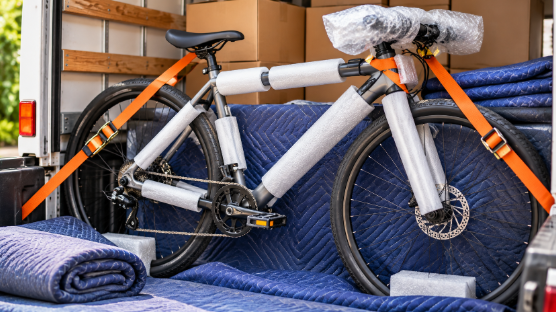
Finally, wrap the whole bike. Lay a moving blanket around the frame and hold it with stretch wrap, soft straps, or painter’s tape. Avoid putting tape directly on the paint, because the adhesive can leave residue or lift the finish. Stretch wrap should go over the blanket, not on bare frame tubes.
Where to Load a Bike in the Moving Truck
Load the bike against a wall of the truck, upright or lying on its non-drive side, and secure it so nothing can shift. The goal is to keep it from rolling, tipping, or taking weight from something else.
An upright bike is easiest to strap, as long as it stands against the truck wall with a strap or rope tying it to a tie-down rail. Place a blanket under each tire so it does not roll, and put the bike in front of soft items such as mattresses or couch cushions rather than hard furniture.
If you lay the bike down, put it on the side opposite the chain (the non-drive side) so the drivetrain faces up and stays clear of the floor. Protect the bike from above too, because the biggest risk is a dresser or box tipping onto it during a turn.
A few loading rules save most bikes:
- Never stack anything heavy on a bike or its wheels.
- Load bikes last, or near the end, so they sit near the door and are not buried.
- Write “bicycle” on the wrapping so anyone handling it knows to be careful.
- Keep the pedal bag, bolts and tools in one marked box that rides in your car, not the truck.
On a longer drive, check the straps after the first few miles. Cargo settles, and a strap that was tight at the curb may be loose by the highway.
When a Bike Shop Box Makes Sense
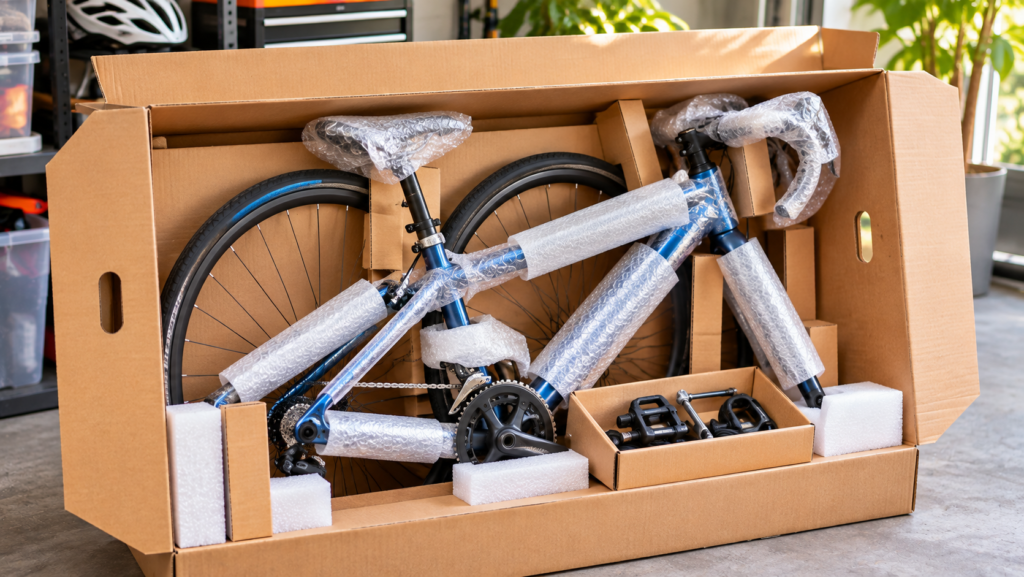
A bike box is worth it when the bike is valuable, the trip is long, or the truck will be packed to the ceiling. It gives the bike a rigid shell that blankets alone cannot provide.
Bike shops often have empty boxes from new bikes and will give them away or sell them cheaply. Ask a few weeks ahead, since stock varies. Check that the frame fits with the front wheel off and the bars turned; mountain bikes and e-bikes usually need a bigger box than road bikes.
Inside the box, keep the frame padded, put the wheels flat on each side of it, and place the pedals and small parts in a bag taped in a spot you will see. Fill the empty space with paper or foam so the bike cannot move. Then mark the box “bicycle, this side up” so it is not buried under heavy items.
Boxing takes longer, and a decent commuter bike on a local move does fine with good blankets and smart loading.
When It Helps to Get Loading Help
If the bike is only one of a hundred things to load and you are short on time or muscle, bringing in people who load trucks for a living can lower the risk of damage. Lift & Load Moving is one example of a Chicago-area company that handles packing, loading and unloading for local and long-distance moves, which is the kind of help worth asking about when a move includes awkward items.
Whoever you choose, tell the crew about the bike before the truck is loaded, point out anything fragile, and say where you want it placed. Also ask how they pad and secure bicycles, since methods vary.
For moves that cross state lines, the Federal Motor Carrier Safety Administration explains that your mover must prepare an inventory of your shipment before or at the time of loading, and that you should note any damage or unusual wear if the driver does not. That is a good moment to mention the bike’s existing scratches and show your photos.
Frequently Asked Questions
Do I have to take the pedals off a bike when moving?
It is strongly recommended. Pedals stick out and can scratch the frame, other items, and people. They also take less than five minutes to remove with the right wrench. Remember that the left pedal has a reverse thread, so turn it clockwise to loosen it.
Can I put a bicycle in a moving truck without a box?
Yes. A well-wrapped bike with padding on the frame and secured against a wall travels fine on most moves. Boxing is better for valuable bikes, long distances, or tightly packed trucks, but blankets, wrap and careful loading are enough for many everyday bikes.
Should I lay the bike down or stand it up?
Either works if the bike cannot move. Standing it upright against a wall with a strap is simple and keeps weight off it. Lying it down works too, on the non-drive side with the chain facing up, as long as nothing heavy sits on top.
How do I move an e-bike?
Remove the battery and carry it separately, in a cool place in your own vehicle. Move the bike body like any bicycle, with extra padding around the motor and display. Check the manufacturer’s guidance for transporting the battery, especially if it is old, damaged, or has been exposed to water.
What is the best way to protect a bike frame from scratches?
Cover the tubes with foam pipe insulation or a moving blanket, then hold it in place with stretch wrap over the padding. Keep tape off the paint. Pad the spots where the bike touches walls, other items or straps, since those contact points cause most scratches.
A Simple Plan for Moving Day
Treat the bike like any other item that costs real money to replace. Clean it, photograph it, take off the pedals, turn the bars, pad the frame and load it against a wall where nothing can fall on it.
Keep the small parts with you, not in the truck. Then, when you arrive, reassemble the bike before you unpack the rest of the house. It is a small win that makes the first ride in your new neighborhood possible on day one.


 By