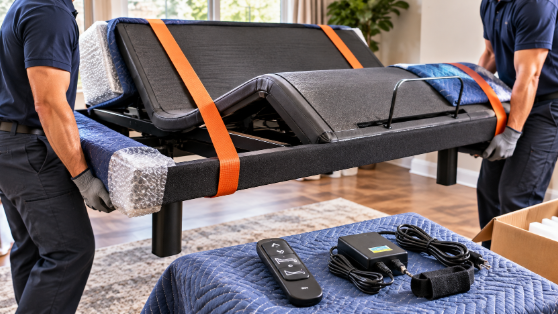
An adjustable bed base is not a normal bed frame. It has motors, a control box and a power cord, and it weighs far more than most people expect. The short answer to how to move an adjustable bed: lower the base flat, unplug it, coil the cord, take off the mattress, and lift the base by its metal frame with at least two or three people. Never grab the fabric or the legs.
That sequence protects the motors, your back and your doorframes. The rest of this guide explains each step, plus the parts most guides skip: what changes with a split king base, why the big mattress brands disagree about taking the base apart, and when a staircase means it is time to call for help.
How to Move an Adjustable Bed: The Short Version
Moving an adjustable bed comes down to seven steps, done in this order.
- Lower the base flat with the remote, so nothing is propped up while you work.
- Strip the bedding and lift the mattress off. The mattress travels separately.
- Unplug the power cord from the wall, then coil it and secure it to the frame.
- Check what your maker says about legs, rails and linked halves before you remove anything.
- Measure the route: doors, hallway turns, stairs and landings.
- Lift by the metal frame with enough people, and set the base down gently.
- Wrap it for transport, then test it with the remote before the mattress goes back on.
Each step has a reason behind it, and a few have exceptions depending on your brand. The sections below cover them in turn.
Know What You Are Lifting Before You Lift It
An adjustable base typically weighs about 150 to 250 pounds, depending on size and model, according to Stearns & Foster’s moving guidance. That figure is for the base alone, with no mattress on top.
Put that next to a common workplace safety rule. A lifting-safety talk hosted by the CDC’s NIOSH says no one person should lift more than 50 pounds, and that heavy or awkward objects call for help or equipment. Run the numbers: a 150-pound base already works out to three people at that guideline, and a 250-pound base to five. Those limits assume a compact load held close to the body. A long, floppy-decked base with motors underneath is a harder case, which helps explain why Stearns & Foster tells owners not to move the base alone.
It also helps to know which kind of base you own. Many king and California king setups are two linked halves, and a split king is two fully independent bases. Sleep Number’s FlexFit guide includes a step for separating the halves of king-size bases before a move. Each half is lighter than a single wide base, which makes carrying easier, but you are now handling two heavy motorized pieces, two cords and two remotes.
One caveat: this guide is about consumer adjustable bases. A rented or medical hospital-style bed may come with its own handling rules, so call the supplier before you move it.
Handle the Power Cord, Remote and Cables First
Unplug the base from the wall before anything else, then coil the cord and secure it so it cannot drag or snag. Stearns & Foster’s checklist gives the same order. The reason is practical: a loose cord can catch on a doorframe or a stair rail, and a carrier who trips with 200 pounds in hand can get hurt fast.
Tie or tape the coiled cord to the frame near the control box, and keep the remote in a labeled bag that travels with the base. On a split king, label the pieces “left” and “right” and keep each remote with its own half. When the base is set up again, that small habit saves a confusing round of guessing which remote runs which side.
Clear the base of everything else too. Pillows, a wedge, a pet bed or anything stored underneath can shift and jam a moving part. Remove it all before the lift.
Lift by the Frame, Not the Fabric or the Legs
Grip the metal frame. The upholstered deck and the legs were not designed to carry the load. Malouf’s owner’s manuals for several of its bases call for two to four people, lifting by the frame rather than the fabric, and avoiding the legs as pivot points because angled pressure on them can cause damage.
Good lifting habits matter just as much as where you grip. The CDC safety talk recommends lifting with the leg muscles, avoiding twisting and planning the lift so the path is clear and everyone faces the direction of travel before the base comes off the floor. Agree on a few things before the first lift:
- Who counts down and calls “set it down.”
- Which direction you will turn at each corner.
- Where the base will rest if someone needs a break.
Standing a base on its side rails is a common way to get it through a narrow doorway. Sleep Number’s own setup steps stand the FlexFit base upright on its side rails, though your model may differ, so check the manual before you tilt. Whatever the angle, keep your grip on the frame and set the base down gently. Stearns & Foster warns that dropping or compressing a base can damage its electrical and mechanical parts.
Should You Take the Base Apart?
It depends on the brand, and the makers do not agree. Sleep Number’s guide walks through removing frame links, rails and legs, and it lists leg removal as a way to gain doorway clearance. Stearns & Foster takes the opposite position. It says adjustable bases are not designed to be disassembled by owners, tells people not to remove legs, frames, motors or electronics, and notes that damage from moving or disassembly is not covered by its warranty.
Same product category, opposite advice. The safe rule is to remove only the parts your own manual names, and nothing else. If you do take something off, a few habits make reassembly painless:
- Photograph every connection before you unplug it, including cables, hoses and any sync cable between halves.
- Bag the screws and small parts, then tape the bag to the frame.
- Label each cable so the left and right sides cannot be swapped.
Can’t find the manual? Search the model number on the maker’s support site. If you still come up empty, leave the base intact and plan the route around it. A bed that stays in one piece cannot go back together wrong.
Some mattress and base combinations also use strong magnets. Sleep Number’s guide includes a safety warning about this, so read the mattress instructions before you detach anything.
Plan the Route Through Doors and Up Stairs
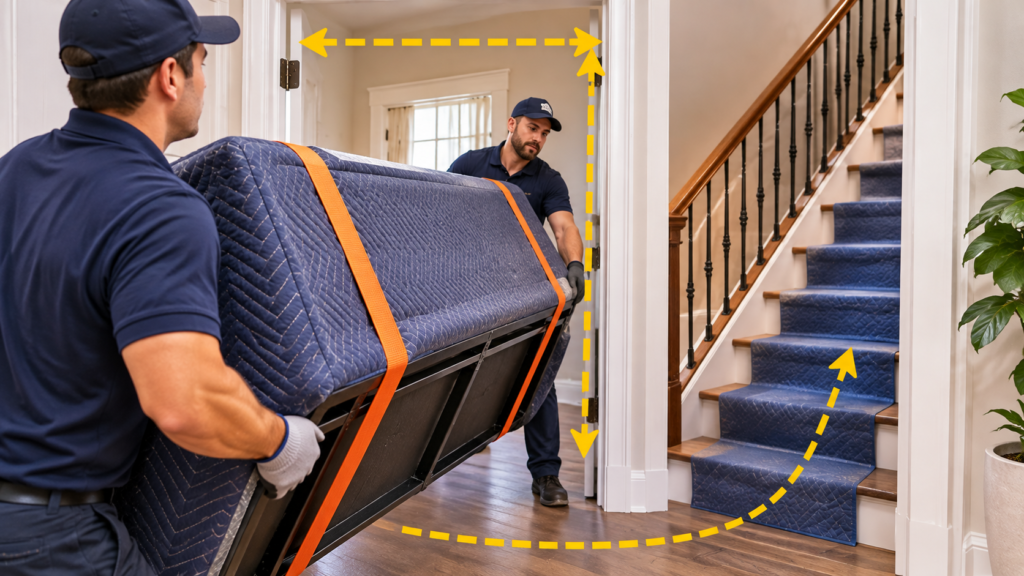
Measure before moving day, because a base that does not fit is a base you carry back. Record the base’s length, width and height with the legs on, then measure each doorway, hallway turn, stairwell and landing along the path. Add a few inches on each side for hands and knuckles.
On stairs, put the strongest, most experienced person at the lower end, since that end carries more of the weight going up or down. Keep the base as level as the stairwell allows, move slowly and pause on landings. Never rush a turn. Most damage happens when someone tries to force a corner.
Sometimes the measurements say no. If the base, a sectional or another oversized piece cannot make the turn, some movers offer another route. Superior Moving & Storage, a family-owned moving company serving Pennsylvania, New Jersey, Delaware and Maryland, is one example of a mover that provides hoisting for large furniture, lifting items through a window or balcony when a stairway will not work.
Whoever you hire, ask three questions up front. Do they handle motorized beds? How many crew members will they send? Does the quote include protective wrapping? Stearns & Foster recommends movers who are experienced with heavy, motorized furniture, so a mover that has done this before is worth more than a low estimate.
Wrap, Load and Test the Base
Wrap the frame in moving blankets or plastic wrap, load it where it cannot slide, and keep anything heavy off the top. Compression is one of the things Stearns & Foster warns about, so no stacked boxes.
At the new home, set the base in its final spot and plug it in directly to the wall. Sleep Number’s setup notes say the outlet should not be controlled by a wall switch, which is a common reason a base seems dead after a move. Then run the base through its motions with the remote before the mattress goes on. Malouf’s setup steps follow the same order: place the base, test it with the remote, then add the mattress.
A good test is simple. Raise the head, raise the foot, return both to flat, and listen for grinding or uneven movement. If a split king’s halves do not move the way they should, stop and check the connections between them. It is far easier to fix a problem with a bare base than with a mattress sitting on it.
Frequently Asked Questions
Can one person move an adjustable bed base?
No. Stearns & Foster says its bases are not designed to be moved by one person, and one maker’s manuals ask for two to four people. A base can weigh 150 to 250 pounds. Even if you could shuffle it across a room, a slip near stairs or a doorway risks injury and damage to the motors.
How heavy is an adjustable bed base?
A typical adjustable base weighs about 150 to 250 pounds, depending on size and model, based on Stearns & Foster’s guidance. That is the base alone, without the mattress. Check your manual or the label for the exact weight, and tell your movers the number so they can plan the crew size.
Can I move an adjustable bed without taking it apart?
Usually yes, and for some brands it is the only approved option. Stearns & Foster tells owners not to disassemble the base, while Sleep Number’s guide describes removing legs and rails. Follow your own manual. If it does not mention taking anything off, leave the base in one piece and plan the route around it.
Can I carry an adjustable base on its side?
Often, but check your manual first. Tilting a base on its side rails is a common way to clear tight doorways, and Sleep Number’s setup steps stand its base on its rails. Keep your grip on the metal frame, never the fabric or the legs, and set the base down gently at the end.
Will moving the base void my warranty?
It can limit your coverage. Stearns & Foster states that damage from moving, transport, improper handling or disassembly is not covered under its warranty. Other makers’ terms differ, so read yours before you remove any parts. Damage in a professional move may also fall under the mover’s coverage, which is worth asking about.
Slow Down, Then Lift Together
Most adjustable base damage comes from small shortcuts: a cord left dangling, a grip on the fabric, a leg used as a lever. Each one is easy to avoid when you take a few minutes before the lift to lower the base, unplug it, coil the cord and read the manual.
On moving day, count the people, walk the route once and agree on who calls the lift. If the numbers or the stairs do not add up, bring in more help before you start, not after something slips.


 By